Translate

Sunday, April 21, 2013

Against The System

So this week Criterion has released it's newest Eclipse box set, and much to my delight, it's subject was none other than Masaki Kobayashi.  Kobayashi was responsible for some of my favorite films coming from Japan in the sixties, and this newest box set takes it even deeper into the mid-late fifties.  While that might seem a little extraneous, I feel that in that period of films, every year meant something different.  It was a period of financial success in much of Japan, but for many people (and many filmmakers, for that matter), the adjustment to post-war life carried the same sting as the war itself; there is no official end to animosity, and many found it hard to adjust their ideals and distrusted the current government who they felt had grown corrupt with commerce and industry.

The post-war treaties had made it impossible to make patriotic films for quite some time, and the jidaigeki genre, which served filmmakers in Japan since even before the war, had matured with the times, and by the sixties, it was being used to even greater social effect.  Akira Kurosawa once said that it was pointless to make a period drama if it didn't have something to say about what was going on now, and there were few who did that to greater effect than Masaki Kobayashi.

Kobayashi spent the earliest part of his career as prisoner of war.  Being drafted almost immediately after he began his apprenticeship, Kobayashi refused being promoted beyond the rank of private and considered himself a pacifist, and it wasn't until his release in 1946 that he was able to return to Shochiku Studios and assist director Keisuke Kinoshita.

It's worth mentioning Kinoshita briefly, as it is very probable to believe that he was a major influence on Kobayashi at the time.  Though working at Shochiku for most of his career, Kinoshita was constantly changing throughout, giving himself new subject matters and genres, or at least new ways of approaching them.  Shochiku was known for it's tales of everyday, working class people, known as shomin-geki, and though directors like Ozu and Naruse were both creating beautiful pieces that reflected the outlook of many Japanese in a more austere, ever simplifying aesthetic, I feel like Kinoshita was more interested in pushing boundaries in new ways of film-making,  as well as exploring the subject of lost innocence, which would become a hallmark of his style.  It is wholly possible that this is where Kobayashi found his voice, among a like-minded mentor who appreciated democracy and who never shied away from his own ideals, and who in fact, grew ever more nihilistic as the sixties approached.

With several of his own films under his best, and after already tackling the direct effects of World War II in The Thick Walled Room (Kabe Atsuki Heya), it was Kobayshi then, who would explore even further into a more pessimistic worldview, directing such masterpieces as The Human Condition (Ningen no Joken), and Harakiri, both startling criticisms of Japan at the time.  The Human Condition especially, was Kobayashi's firm and unrelenting criticism of war and the macho indoctrination of Japanese males at the time.  Ever the pacifist, Kobayshi was able to say more about the war with single gunshots than near any other film of that time, as in any of his films, violence never supplements morality.
It is also very important to mention Kobayashi's relationship with actor Tatsuya Nakadai, of who Kobayashi would help to launch the career of and form a like-minded friendship with throughout his career.  Though overshadowed in cinematic history by Akira Kurosawa (and it would be Kurosawa's films that Nakadai is often famous for), Kobayshi and Nakadai made 11 films together, and those films are more important to me than any such films by Kurosawa.  That isn't to say that I don't love Kurosawa, but there is something about the almost counterculture nature of Kobayshi's films, along with his beautifully sweeping camerawork and collaborations with Toru Takemitsu (who was also more well know in his collaborations with Kurosawa, as well as countless other directors of the time) that resonated more with me.  It's not that the elements of his films aren't seen in the corners of popular Japanese cinema at the time, but what is so appealing about Kobayshi is that he was able to fashion all of those elements into something edgier; whittling his blunt stick into a sharp, stabbing tool, ever piercing and ever haunting.
Also, to point out, spell check tries to correct me when I write the name Kobayshi, but not Kurosawa, and that's kinda bullshit.

Saturday, April 13, 2013

My Most Nostalgic Nightmares


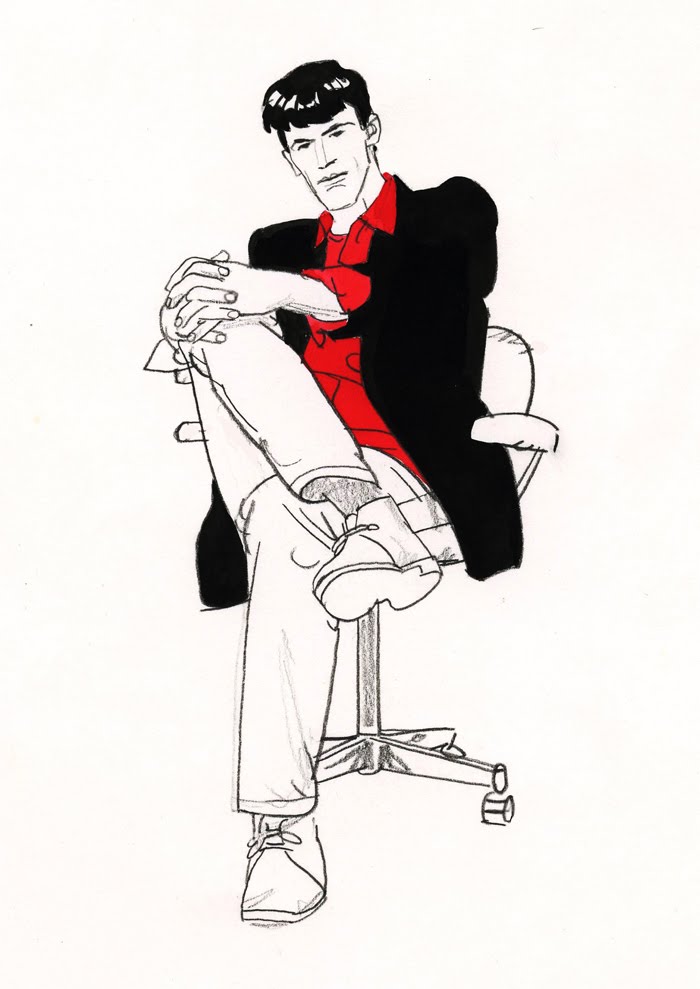
Spring for me is a great time to revisit a lot of works that I've grown fond of over my short lifetime.  Maybe it's the state of transition, much like autumn, that makes me nostalgic, or maybe it's the spring-cleaning inventory that one does that let's me see what I have amassed over the years; and beyond that, what is worth reliving as an almost anniversary.  So: Dylan Dog.
Dylan Dog was admittedly a pretty late entry to my cannon, but for some reason i feel like I've spent my whole life with him.  I can't tell if it's just me, but I would venture to guess, based on the worldwide success of the Italian comic, that quite a few others have shared in my experience.  Unfortunately, English-only readers have had to settle for a measly six issue miniseries plus single special issue published by Dark Horse Publishing in the US.  Not that I am complaining, as the collected edition still clocks in at a respectable 680 pages, but Italian fans were treated to over 300 issues!  Granted, I'm not a huge fan of overly-long running serials (in fact, I would rather take a short, strong, finite story over an ongoing series in most cases), but every time I close this book I can't help but want to read more, and despite being set in London, I haven't been able to find any other English language issues being published even in the UK, though I would love to be proven wrong in that reguard.
To give a quick description of the book, Dylan Dog is a nightmare investigator.  Though mentioned only briefly in the English language version (as again, there are only seven out of 300+ issues), Dylan Dog was once a member of Scotland Yard, and though he is now a private contractor, he is often aided by, or himself aides, Inspector Bloch, his former superior in his previous post.  Bloch functions as a rational father-figure, though he is never one to completely disreguard Dylan's supernatural theories or explanations.  Rather, he acts as a starting point for the reader into the more fact or proceedural-based issues within some of the individual cases.  It's through him that we often learn about what is really going on in the concrete sense, and he often acts as a springboard for Dylan's more far-fetched speculations, even moreso sometimes than Dylan's own assistant Groucho (changed to Felix in the English language adaptation, due to a conflict with the estate of Groucho Marx, complete with alterations to remove the character's signature mustache).  If Bloch functions as the rational father character, then Groucho does his best impersination of the comic relief, though his inexhaustable jokes wear on even the characters themselves, while still managing to squeak out a few chuckles from the reader.  The character itself is almost a running joke, as he is on more than a few occassions always there in the nick of time to throw our hero a revolver, saving his life (much like Hellboy always falling through floors, and Adèle Blanc-Sec's consistantly, similarly bearded men).
An altogether not wholly original concept, Dylan Dog manages to stand out on the merit of it's protagonist.  Instead of taking itself too seriously, the stories have a kind of natural comedy to them, and they almost distance themselves from their subject matter; it feels like for every story that is centered around an actual case he is hired for, there are two more that are based on happenstance, and the character is merely a passanger along with the reader.  There are countless pop culture references, from the theme from Ghostbusters in the background, to even the appearance of Dylan himself, admitted to be based on the likeness of actor Rupert Everett. 
Dylan is a hopeless romantic, and like Chekov's gun, if a woman is introduced, Dylan is almost certain to fall in love with her, further complicating things beyond their already convaluted meanderings.  This sense of romance, perhaps is what makes me hold Dylan Dog in such a nostalgic light.  There are hintings of his past and a sense of melancholy and lonliness in his otherwise mundane demeanor, and despite their unwavering, almost casual violence, his tales have a lightness to them that invites the reader back time and time again.  Though there is some carryover between stories, they remain largely stand-alone episodes, and perhaps that's what is so inviting as well.  As much as I love them, I can always skip over stories like Morgana, which, admittedly can give me quite a headache if I'm not in the mood for it.

If you're a fan of any of the other stuff I have mentioned, I would say to give this one a try as well.  For me, Dylan Dog sits at the same table as Adèle Blanc-Sec and Hellboy, with a place card reading "Pulp-Horror Plus".  Each has the excellent ability to transcend genre conventions and become cultural icons in their own respective decades and countries, and all have become inspirations for films based on thier exploits (in fact, Cemetary Man was based on another novel by Dylan Dog creator Tiziano Sclavi and starred none other than Rupert Everett).  To be totally honest, I couldn't make it past the first five or ten minutes of Dylan Dog: Dead Of Night.  From what i saw, it shared almost no similarities aside from a name and a red shirt, and I don't think I missed too much.  Either way, as is almost always the case with cultural icons in comics, skip the film, read this book.

Thursday, April 4, 2013

I Can Hear The Sea

Ocean Waves, or I Can Hear The Sea (海がきこえる Umi ga kikoeru) is a made for TV film directed by Tomomi Mochizuki and produced by animation powerhouse Studio Ghibli.  Apparently it was based on a novel as well, but I have never read that, so I couldn't really attest to how the film version compares.  Either way, I love this film.  It actually comes in right behind Porco Rosso as my favorite Ghibli film, though it is very much unlike any other film they have made.  This makes sense though, as this film was meant to give the studio the chance to make a much cheaper production using their younger staff members (though it did go over budget and schedule).

The story take place mostly in Kōchi, and is told in a flashback of protagonist Taku Morisaki reminiscing over who he comes to realize was his first love, Rikako Muto, after seeing a familiar woman on a train platform in Tokyo.  It's a simple enough story, and it lacks much of magical realism or fantastical elements that Studio Ghibli is most notable for, but the maturity and subtlety of Ocean Waves is instantly apparent and one could find it's contemporary love story just as whimsical as a flying pig or a bathhouse populated by spirits.

Rikako is from Tokyo and desperately misses home, and manages to offend almost everyone in her new school (of which Taku attends), not the least by making fun of Taku's Kōchi dialect, saying that he sounds like he is in a Samurai movie, and it's this comparative approach that Rikako is taking that is the cause of her social stryfe.  She becomes ostracized from her fellow students by placing herself above them, and though she says she doesn't care what they think, there is still a real sense of isolation and lonliness in her that only adds to her poor attitude towards her peers, and one that Taku is obviously annoyed and angered by despite his willingness to help her with her many problems.

Ocean Waves manages to use it's brevity to it's advantage, as any conflict is easily ascertained and the surrounding emotion is related to the audience immediately.  This is an impressively relate-able film, and despite some moderate predictability, it manages to be engaging from very early on.  In fact, I think that it's that instant relate-ability and predictability that makes it compelling and engaging, and it feels more like you are actually the one reminiscing rather than watching the characters go through the motions; somehow the fact that it is animated actually helps with this, as there isn't the normal relationship that the viewer often builds with the actor playing the part who that viewer may have any preconceived opinions about.  The characters are simply that --characters.  They remain those roles forever, and their story as we know it ends with what we're presented in the film.
If you have ever liked a girl, you should watch this movie.

Tuesday, March 26, 2013

The Most Beautiful Soundtracks Of François De Roubaix

 So, I recently picked up volumes 1 and 2 of Les Plus Belles Musiques De Films De François De Roubaix.  These are part of what I am pretty sure is a three volume series, designed as a kind of "best of" collection, putting together some of François De Roubaix's most famous film soundtracks.
For the most part, there is only one track from each soundtrack, though it appears that he has used some of the same music for multiple films.  Those specific tracks still differ from each other, and they are placed strategically throughout their respective volume, so it gives the sense of an actual album instead of just a collection of songs, which I feel pretty good about.
The nicest thing about these collections, is that while they can still be a little pricey depending on where you find them (volume 3 was still a little too pricey for me when I last looked), this collection is still way way less expensive than trying to find some of the records that were released specifically for each movie, and some of them don't even exist, according to my own research (which I would love to have proven wrong, if anyone could help me out).  Either way, I have been looking for an affordable vinyl copy of Le Samouraï for years, and while I may never find that, even having one selection from that film on wax is exciting to me.
Some of his music reminds me a little of pre-YMO Ryuichi Sakamoto, and I wouldn't call it too much of a stretch to say that the latter was probably influenced by the former, though that is just speculation on my part.  Unlike Sakamoto, however, Roubaix was a self tought musician, studying and learning jazz at around fifteen years of age.  His father was a filmmaker as well, and François got his start by getting to score his his educational films before moving on to work for directors like Robert Enrico and Jean-Pierre Melville; completing over fifty film scores before his fatal diving accident in 1975 (his final score, Le Vieux Fusil, was released posthumasly in 1976 and received a French César award in that same year). 
Though as above, I haven't found any evidence to support this theory, I would also wager that Roubaix was heavily influenced by Claude Debussy, who not only influenced entire generations of jazz musicians, but was also a heavy influence on other composers who worked for film, such as Phillip Glass, Toru Takemitsu (who had to have been an influence on a young Roubaix), and even the above mentioned Ryuichi Sakamoto.
François' style is comprised of a myriad of sounds; at once rooted firmly in both folk and jazz instrumentation, he is often wont to include electronic instruments like more modern synthesizers of the time, and even early drum machines, and could even be categorized as musique concrète (which was invented by French composer, Pierre Schaeffer, and based on principles developed simultaneously by both Schaeffer and Takemitsu; which supports my above theory just a tiny bit).

I find it hard to differentiate between his later influence and those he influenced, as many of his contemporaries continued making music long after Roubaix's early death, but either way, his style can still be heard throughout much of the later krautrock and post-rock scenes in both Europe and America.  I have heard similar sounds in modern groups like Stereolab, Nobukazu Takemura, and much of the Chicago post-rock/jazz scene, though his is obviously not the sole influence within those groups.
Those not interested in spending too much can still find some great reproductions of his work through a series of CDs on France's Emarcy Import label.  In fact, my first introduction to the film Les Aventuriers (now one of my favorite movies, and probably the subject of a future post) was by buying the Le Samouraï /Les Avenureirs CD on Emarcy.  Either way, I wholeheartedly recommend anything you can get your hands on, especially if you are familiar with any of the other musicians i mentioned but are still new to François de Roubaix.


Saturday, March 23, 2013

If It's Spring And You Know It Clap your Hands

Weeellllll, Spring is finally here, so it seems only fitting to try to beat my old clapping record and reread/rewatch Blue Spring, by Taiyo Matsumoto (film version appropriately helmed by 9 Souls and Pornostar director Toshiaki Toyoda).  If you are or were ever a young man who has ever been bored or pissed, you will almost certainly find something in common with Blue Spring, whose title refers to the emotion and season, respectively.

For the boys of Kitano High School, spring signals the approach of a summer that can't come fast enough.  Their days are pained with boredom and rebellion, and punctuated by violence and a dangerous game where they are willing to bet their very lives to set a new record and gain the respect of their fellow students.  It's as if the longing for adulthood were so excruciating that they would rather chance young death than die of boredom.  They talk crudely, write graffiti, get in fights, and make more than a few passing remarks about masturbation and sex, all the while competing for popularity and respect.

Throughout the seven separate stories, the narrative seems fragmented and unrelated at first, though it quickly becomes apparent that throughout each individual character's vignette, a larger picture is forming of a school whose students have no role models and where every adult in their life has essentially given up on them.  They exist in a world that is very much their own, where they have built their own hierarchies and social dynamics without any sense of consequence outside that world.

Kitano High brings to mind the Eighth District Youth Vocational Training School (8th District Youth Prison! Entry Free!) from Akira, by Katsuhiro Otomo.  In Akira, Otomo uses the Youth Vocational School to help give life to a larger story, where every character and location helps to create a believable Neo-Tokyo; itself a larger backdrop for a very personal story with cosmic repercussions.  Matsumoto's Kitano High on the other hand, is the key to Blue Spring; it's the feeding trough, the water cooler, the melting pot where everything takes place.  It is the crux of everything for these students whose episodes we get to see.  It is a place that embodies and magnifies every negative element of their lives.  It is where every bad habit is nurtured and festers, despite the attempts of a few teachers who you get the impression actually care.  Even the school principal delights in seeing the students entertain themselves with their deadly game, and whose own statuettes of dollars signs and calligraphy scrolls reading "Nothing Beats Money" is reflected in the students' graffiti; and while the principal himself engages in an abusive relationship with his secretary, it is hard not to see the correlation between how these young men view their surroundings and how they live out their own social dichotomies.
The graffiti serves another purpose as well, letting the audience see the authors influences, turning the manga into a kind of high school notebook, giving the sense that this is a novel about a very specific youth, and this is less a random set of stories and more of an autobiography.  Matsumoto-san literally writes his influences on the walls; from specific works like Otomo's Boogie Woogie Waltz and Jean-Jacques Beineix's 37°2 le matin (Betty Blue) to including names like Kurosawa, Nakagawa, Ohta, Inoue, and Takada, in which he lists, almost as a timeline of important people, right before the names of his protagonists, Kujo, and then Aoki, who who has just unseated his predecessor.  The characters of Kujo and Aoki themselves bring to mind the relationship between Akira's protagonists, Kaneda and Tetsuo.
There is a wonderful quality about his drawings that make them seem light and effortless while still being intricately constructed and complex.  The signs and graffiti that seem so haphazardly placed have real purpose in the story, and it's easy to get a sense that they were meticulously placed; much like so many other Japanese arts, where the intention is to give the feeling that everything is placed there naturally, as if that is the only place it could be, Matsumoto almost crowds his panels with scribblings but manages to never overwhelm the reader or have anything seem out of place.
The film version focuses mainly on the opening story concerning characters Kujo and Aoki, entitled If You're Happy And You Know It Clap Your Hands, though it manages to weave in pieces of the other stories while maintaining a more focused narrative structure.  As opposed to the manga, which tells each story in turn, Toyoda's film uses the tale of Kujo and Aoki as the main body of the work, taking moments to explore the other characters and their specific vignettes to paint a larger picture of Kitano High.  As the stories follow no real linear fashion, the viewer finds it easy to return to the main protagonists and pick up right where they left off.  Finally, the film's more classic style of photography meshes well with the subject matter, and the rock soundtrack by Kenji Ueda takes it right where it needs to be: balancing right on the edge of beauty and nihilism.
Blue Spring is one of the few occasions when a film lives up to it's source material.  I am usually not a fan of comic adaptations, and generally believe that too often comics are used as glorified storyboards rather than it's own separate medium, but ever once in a while something comes along and becomes the exception to the rule.  I love film and comics for totally different reasons, and most of the time, great comics are great because they are comics; the medium they exist in has certain allowances that other do not, and a great story that is written specifically for one format or the other has difficulty translating that experience.  Blue Spring, however, works as both a film and a comic book.  The manga gives you the ability to pour over every page and examine the subtext of the graffiti at your leisure (even the English language edition, in which Kelly Sue DeConnick masterfully and painstakingly translates every scribble), while the film's pacing and accompanying music make it an antithesis to any classic coming-of-age tale.  We see this film not as a transition for these boys, but as the most important moment of their lives.  Every choice they make affects them in the here-and-now.  There is no future for some of them, and we find it painful to think of what made them this way.  Blue Spring sits as a sign in the hallway, offering us a small service for ¥100: Know Your Future, Forget Your Past.    

Tuesday, March 19, 2013

Better Late (or Tardi) Than Never

After stumbling upon The Extraordinary Adventures of Adèle Blanc-Sec early this past winter, i found myself invariably getting lost down a Jacques Tardi rabbit-hole.  I can honestly say that I didn't expect where I found it leading, but I couldn't be more pleased with where it took me.

As I understand it, Jacques Tardi apparently got his start in comics after attending schools in both Lyon and Paris for fine and decorative arts, respectively, when he joined the likes of Albert Uderzo, Philippe Druillet, and Morris (the working name of Belgian comics artist Maurice De Bevere), on the renowned French periodical Pilote, where he even illustrated short stories for comics legend Moebius, alsoamong the publication's ranks.  He later went on to do work on several other publications, such as Métal Hurlant and À Suivre, where he would continue to collaborate with other well known authors such as Jean-Patrick Manchette and Jean-Claude Forest.

Moving on from his impressive history, Jacques Tardi's work more than speaks for itself, and despite his clean, cartoon-like line work, his stories are still very mature and at times among the bleakest I have ever read.  Don't mistake bleak for dreary though, as much of his work still manages to include a lot of humor and action, especially his adaptations of Jean-Patrick Manchette, who i would list as my favorite among his illustrious collaborators.

West Coast Blues was the first of the Manchette stories I read, and I instantly understood what was so popular about this book.  The frank, derisive attitude of the protagonist immediately brought to mind the most hard-boiled of pulp heroes I was already familiar with; but instead of aimless rage, I found more melancholy in the character of George Gerfaut.  From the very beginning we are introduced to a man fed up with his current situation in life, and are immediately told of his past deeds which we are about to read.  In contrast to Tardi and Manchette's eponymous sniper, Martin Terrier, who lines up his shot with mute efficiency, Gerfaut is simply a man caught up in a situation in which he is bluffing his way through, though he comes to find a kind of tranquility in his escape from his more mundane surroundings.
Again, in contrast with his West Coast Blues counterpart, Martin Terrier is a much less dynamic character, betraying any impression the reader might get of a character in chrysalis.  He instead is often contemplative of the past, acknowledging the moments that shaped his life while still being either unable or uninterested in changing his character to redefine his future.  Both stories however, share similar sensibilities, and the observant reader will catch clever artistic cues that will keep the pages feeling ever thoughtful while never slowing down the pace of the storytelling.

In the books of his that i've made my way though so far, It Was War Of The Trenches stands out as his heaviest collection.  The stories are bleak, vulgar, and riddled with the kind of violence that sits in the pit of your stomach and refuses to digest, no matter how hard you try.  In an introduction to the book (the edition released by Fantagraphics books, who are responsible for most of the English language Tardi I have come accross, and whose editions I am reviewing in this post), Tardi hismelf admits that most of these stories are fictional.  The gravety of each vignette is nonetheless felt throughout, and the reality of each individual's plight is engrained in the reader despite knowing that most of these characters are fabrications, though all are still representative of the average French soldier in the trenches during The First World War.

All in all, I will say that I am a tremendous fan of Jacques Tardi thus far.  He (like much of the European comics scene I have seen) has the wonderful ability to bounce between genres and subject matters effortlessly; from his delusional and at times madness-inducing Arthur There (You Are There/Ici Même), his singular female lead Adèle Blanc-Sec, and everyone else in between, the reader never feels as if he is out of his depth, and instead is brought ever deeper into the understanding of a man who is able to illustrate so much with so few lines.  Fantagraphics has a few more books of his lined up (Goddamn This War!, The Astonishing Exploits Of Lucien Brindavoine, Run Like Crazy Run Like Hell), and I am anxious to spend much of my summer getting through them; and with the promise of more extraordinary adventures from Mlle. Blanc-Sec, I'd say English language readers have a lot more Jacques Tardi to look forward to.
 

Saturday, March 16, 2013

New(ish) Catune!

Man, Catune just keeps putting out music that I love.  Straight outta Tokyo, Catune was founded by Kensuke Saito of 9dw, and for some reason he is on some insane mission to only release music I want to hear.  Though initially only releasing records from Japan, they are incubating a pretty solid roster of international artists, and i wouldn't be surprised to see them get even more successful, as they hold a pretty firm seat among the best coming from independent music in Japan.

I recently was able to hear their upcoming release from Windsurf/SHOCK alumni Sorcerer, and i couldn't be more excited to get that one in the mail in April.  My first introduction to Windsurf was from a 9dw remix of Weird Energy, but i was super into it.  I checked out their first Windsurf EP after that and was super into that, and everything i've heard from the Weird Energy album was fantastic and exactly the kind of super-pretty, ambient downtempo-y, house-y shit I wanted to hear.

Well, wither way, this new Sorcerer release is is on the same kind of wavelength.  It's got a little more of a deep house feel to it, but it's still super upbeat and proves to be even more accessible than the Windsurf material.  I've always been a sucker for the simple two-chord structure, and this record has got that in spades.  No matter how far away it gets, both the title tracks keep themselves firmly grounded within that structure without ever getting monotonous.  The remixes get a little deeper than their original counterparts, but never lose the spirit of the record's intended feel.  Check out the sound samples here:
Step Pyramid/Universal Vision EP


I will admit to knowing pretty much nothing about Lord Of The Isles.  A little detective work has told me that he's a UK producer from Scotland, and that wounds pretty cool to me.  Apparently his real name is Neil McDonald, and like a lot of other UK producers I know so very little about, he's got quite a few other records that are probably worth trying to scoop up down the line.

Either way, his recent release on Catune is super good and worth grabbing now if you can find a copy.  Like the Sorcerer record, it has a deep-yet-accessible feel to it, especially if you're familiar with any of the records coming off of the 100% Silk record label out of the States.  Again, you can check it out here:
Geek Chic/Radio Lollipop EP

 A little more detective work has proven that he is worth investigating further: